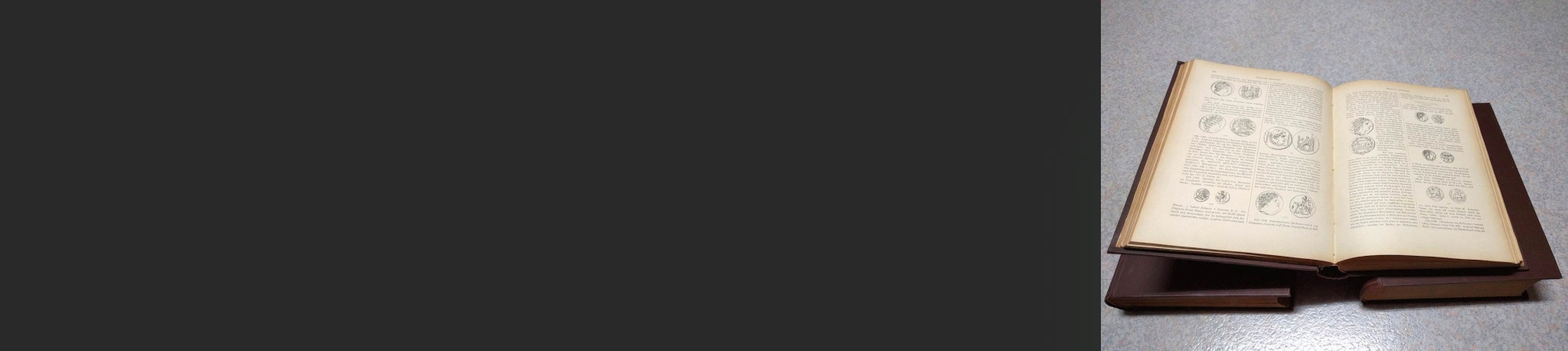
4to. (IV),XL,416,210 p., frontispiece, 1 plate. Calf 29.5 cm (Ref: Hoffmann 2,569: ‘Im Text des Lykophron liess der Herausgeber vieles unverbessert, obwohl er einiges trefflich verbesserte. Mehr leistete er in dem Commentar des Tzetzes, den er auch latein. übersetzte’; Brunet 3,1248: Cette édition, peu commune en France’; Ebert 12548; Graesse 4,309) (Details: Brown morocco, first half 19th century, at any rate before 1857, the work of the English bookbinder ‘C. Smith’ according to a very tiny stamp on the verso of the first flyleaf. In the ‘Database of Bookbindings’ of the British Library one can find images of 3 other beautiful specimens of this master-binder, c155b17, c151k16 & Davis259. The back has 5 raised bands, and is gilt with palmette motifs; gilt lettering in second compartment; other compartments of the back strip gilt with repeated voluté’s and triangles; boards with double fillet gilt borders; gilt corner pieces with floral motifs; thrice gilt fillet borders on the sides, and on inside of the boards; all edges gilt; marbled endpapers. Engraved armorial bookplate on the front pastedown. Frontispiece of Cassandra as a prophetes, engraved by Aloysius Agricola, with at the foot the text of Aeneis 2, vss. 246/74. Engraving of the ‘Gemma Maffei’ by G. Petrini on the title, at the foot another Cassandra quote from the second book of the Aeneis, vss. 403/4. 1 engraved plate, showing two Cassandra gemmae, by Dom Campiglia & Vin. Francescini) (Condition: A fine copy. A touch of rubbing to the joints; 1 small scratch on the 3rd compartment. Some surface wear to the upper corner of the lower board. The binder has bound by mistake the ‘commentarius’ of 210 pages before the Greek text) (Note: Leopoldo Sebastiani, Italian classical scholar, priest and missionary. His exact dates are sofar unknown. At the end of the 18th century he was still a young man, for in the ‘Bibliothecae Josephi Garampii cardinalis catalogus’, Rome, 1796, p. 40, he is called ‘Juvenis in recondita Graecorum eruditione valde versatus’. In this catalogue a future edition of the scholia to Homer of Eustathius is announced, a project that was apparantly aborted. The young man then turned to the Greek poet Lycophron, 3rd. century A.D. for an edition of his Cassandra, also known as Alexandra. The poem of 1500 iambic trimeters tells the profecies of the Trojan princes Kassandra, the fall of Troy and the fate of the Greek heroes. At the end are the profecies of the future supremacy of Rome. Sebastiani’s edition is an ambitious one. After an introduction we find the Greek text, with a facing translation into Latin, made by the Dutch classicist Canter (Basel, 1566). Below the translation comes a Latin paraphrasis produced by Sebastiani. Added are the ‘variantes lectiones’, the extensive scholia, and the emendations to the Scholia. At the end a ‘Selecta discrepantium lectionum silva’. Then an index to the Cassandra and the scholia; then follow 210 p. with the Latin translation of ‘Isaaci sive Johannis Tzetzae Commentarius’, and notes to the commentary. (The byzantine scholars Isaac and Johannes Tzetzes, who were brothers, lived in the 12th century) Three indices disclose this commentary. The contemporary reviewer of the GGA (Göttingische Gelehrte Anzeigen) calls the translation of the commentarius ‘unendlich besser’ than the translation of Basel, 1558. GGA praises Sebastiani’s search for manuscripts of the Cassandra, the oldest of which dates from the 9th or 10th century, and which was once the property of Fulvius Ursinus. GGA: ‘Alle Codices habe er mit der grössten Genauigkeit vergliche; das grösste Verdienst eignet er sich um die Scholien zu, worin er an 2000 Fehler verbessert habe’. (…) ‘Diese (i.e. Gelehrten) wirden finden, dass ihnen ihre Forschungen durch das was S. geleistet hat, sehr erleichtert sind’. The German reviewer is impressed, because Sebastiani produced this edition in the turmoil of an adventurous life as a missionary and a diplomat. He records 2 long travels to the Orient, up to Ispahan in Persia. Back in Constantinople Sebastiani was an honoured guest of Lord Elgin, because he had saved two Englishman. From another source we learn that the English held Sebastiani in high esteem ‘for the losses he sustained, and misfortunes he suffered in consequence of important services which he gratuitously rendered to the British government while resident in Persia as president of the missionaries sent by the Church of Rome’. (Th.H. Horne, ‘An introduction to the critical study and knowledge of the Holy Scriptures’, London, 1818, vol. 2, p. 189). The reviewer of GGA rebukes the Latin of Sebastiani, he calls it ‘oft sehr Orientalisch’. (Göttingische gelehrte Anzeigen, Göttingen, 1804 p. 340/4). A later French reviewer exclaimed: ‘Mais quel latin!’ Sebastiani is probably best known for his excellent translation of the New Testament, published in London in 1817. Th.H. Horne places this translation alongside those of the giants Erasmus and Beza, ’those of Erasmus, Beza and Sebastiani are particularly worth of notice’. ‘In all doctrinal points, this version is made conformable to the tenets inculcated by the church of Rome’. (Horne p. vol. 2, p. 226). Sebastiani is also known for his ‘Storia dell’Indostan’ a history of India, published in 1820. He also translated parts of the Bible into Persian) (Provenance: bookplate with the coat of arms of ‘Joseph Neeld’, with a banner reading: ‘Nomen extendere factis’. Neeld, 1789-1856, was a wealthy English philanthropist, who had a good library and art collection. He was in 1830 Member of Parliament for Gatton, a rotten borough with six houses and one elector, but sending 2 members, which was abolished by the Reform Act of 1832. (Source Wikipedia)) (Collation: a6, b-e4, A-3F4) (Photographs on request) (Heavy book, may require extra postage)

LUKOPHRONOS TOU CHALKIDEÔS KASSANDRA. To skoteinon Poiêma; Kai eis auto touto ISAAKOU mallon de IÔANNOU TOU TZETZOU EXÊGÊMA. Lycophrois Chalcidensis Cassandra, obscurum poema ope XVI. codicum MSS. sanioribus subinde lectionibus restitutum, fideliori interpretatione exornatum, et accurata paraphrasi explicatum; cum Isaaci vel potius Johannis Tzetzae commentario. Ex postrema Oxoniensi editione ad fidem XIII. exemplarium bis mille ferme in locis emendato, notabiliter aucto, latine reddito, et illustrato. Accedunt fragmenta undique collecta, variantes lectiones, emendationes, et indices necessarii, studio et impensis Leopoldi Sebastiani.
€ 1.000,00
🔒 Safe & Secure Checkout


| Gewicht | 2000 g |
|---|---|
| Publisher | |
| SortedBy |
Gerelateerde producten
-

Epigrammata et poematia vetera. Quorum pleraque nunc primum ex antiquis codicibus & lapidibus, alia sparsim antehac errantia, iam undecunque collecta emendatiora eduntur.
€ 750,00 -

ARISTOTELOUS ÊTHIKÔN NIKOMACHEIÔN biblia deka. Aristotelis De moribus ad Nicomachum libri decem. Ita Graecis interpretatione recenti cum Latinis coniunctis, ut ferme singula singulis respondeant: in eorum gratiam, qui Graeca cum Latinis comparare volunt.
€ 1.000,00 -

Aristotelis Politicorum libri octo ex Dion. Lambini & Pet. Victorii interpretationibus puriss. graecolatini, Theod. Zvingeri Argumentis atque Scholiis, Tabulis quinetiam in tres priores libros illustrati, Victorii commentariis perpetuis declarati, Pythagoreorum veterum Fragmenta politica, a Io. Spondano conversa & emendata. Index rerum & verborum pleniss.
€ 1.700,00 -

Joannis Alstorphii J.U.D. Dissertatio philologica De lectis. Subjicitur ejusdem De lecticis veterum diatribe.
€ 260,00 -

ARISTAINETOU EPISTOLAI. Aristaeneti Epistolae graecae. Cum latina interpretatione & notis. Altera editio emendatior & auctior.
€ 740,00 -

De vasculis libellus, adulescentulorum causa ex Bayfio decerptus, addita vulgari latinarum vocum interpretatione.
€ 800,00 -

Torchilli Badenii Jac. fil. Roma Danica, harmoniam atque affinitatem linguae danicae cum lingua romana exhibens. Editio altera priore anni 1699 auctior et emendatior curante Torchillo Badenio pronepote.
€ 90,00 -
Rerum gestarum qui de XXXI supersunt, libri XVIII. Ope MSS. codicum emendati ab Henrico Valesio, & auctioribus adnotationibus illustrati. Necnon excerpta vetera de Gestis Constantini & Regum Italiae. Editio Posterior, cui Hadrianus Valesius, F. Lindenbrogii in eundem Historicum ampliores observationes, et collectanea variarum lectionum adjecit, … emendavit, notisque explicuit.
€ 750,00 -
A collection of dissertations: 1, Petrus Nieuwland: Dissertatio philosophico-critica De Musonio Rufo philosopho stoico. (Praeside D. Wyttenbachio, 1783) (Bound with:) 2, B.P. Van Wesele Scholten: Dissertatio philosophico-critica De Philosophiae Ciceronianae loco, qui est De Divina Natura. (Praeside D. Wyttenbachio, 1783) (&:) 3, B.P. Van Wesele Scholten: Dissertatio juridica De foedere Madritano, quod Franciscus I. Rex cum Carolo V. Imp. captivus fecit. (Praeside H.C. Cras, 1784) (&:) 4, Benjamin Petrus van Wesele Scholten: Dissertatio juridica inauguralis, Ad fragmentum Scaevolae, quod exstat in Leg. CII Princ. Dig. de Solut. et Liberat. (Praeside D.G. van der Keessel, 1785) (&:) 5, David Jacobus Van Lennep: Disputatio juris, sive ethico-juridica De loco Ciceronis qui est De Finibus Bonorum et Malorum. (Praeside H.C. Cras, 1793) (&:) 6, E.C. d’Engelbronner: Disputatio juris De loco Ciceronis qui est De Legibus. (Praeside H.C. Cras, 1802) (&;) 7, Jo. Conr. d’Engelbronner: Disputatio Historico-critica De M. Tullio Tirone M.T. Ciceronis liberto. (Praeside D.J. van Lennep, 1804) (&:) 8, Eliae Caroli d’Engelbronner: Oratio de Stoicorum, doctrinae in primis moralis, prae Epicuraeorum ratione praestantia. Habita, in templo Sancti Martini, quod Majus dicitur, A.D. XI. Septembris ann. 1805 cum Gymnasii Bomeliensis rectionem auspicaretur.
€ 280,00 -
De Belydenisse van S Augustyn. (Nu onlanghs uyt het Latijn in het Duytsch overgeset door eenen Eerweerdigen P. der Societeyt Jesu)
€ 125,00