12mo. (XXIV),935,(1),56 (recte 60) p. Contemporary boards 14 cm (Ref: Breugelmans 1624,2, with a note on the date, he suggests a date after 1626; Hoffmann 1,254, a very elaborate description; Dibdin 1,299; Smitskamp, The Scaliger Collection 5; Brunet 1,453; Moss 1,94: ‘a beautiful edition’; Graesse 1,207; Ebert 1090) (Details: Greek text and Latin translation. Binding: marbled paper over boards. Back ruled gilt, and with a red letter label. Edges dyed red. Printer’s device on the title: a shoveling farmer, above his head the motto ‘fac & spera’. 6 woodcut initials) (Condition: Binding worn at the extremities. Paper on both joints split. Back rubbed. Front flyleaf gone. Inner hinge a bit weak. The title leaf shows two small tears in the gutter) (Note: This edition has been praised by some critics; it contains a few short but useful notes by the famous French scholar Joseph Scaliger, 1540-1609. § Of the Greek comic playwright Aristophanes, ca. 455-385 BC, born in the radical democracy of Athens, survive 11 plays. In a less free society his genre became obsolete in his own time, and was later replaced by the harmless plays of Menander. ‘Aristophanes’ comic mode- a dramatic free form with an almost improvisational feel, great poetic and linguistic inventiveness, highly topical satire (public figures being named and personated on stage), and obscenity, beyond almost any subsequent standard of acceptability’- never again became a major theatrical tradition’. (The classical tradition, Cambridge Mass., 2010, p. 69) This opinion seems outdated. Aristophanes sounds very much like modern satyric comedy. He seems to be the creator of his own genre. The 2nd edition of the OCD, 40 years older, sounds more sympathetic. ‘He had a keen eye and ear for the absurd, and the pompous; his favoured media are parody, satire, and exaggeration to the point of phantasy, and his favourite targets are men prominent in politics, contemporary poets, musicians, scientists and philosophers, and (…) for a wide public’. (OCD 2nd ed. p. 113) § Serious scholarly work on the text of Aristophanes begins in the 16th century, with Petrus Victorius, J.J. Scaliger and his friend Willem Canter. A new edition with Scaliger’s notes was published posthumously in 1624 by Maire in Leiden, this edition. That Scaliger, a man with a sharp tongue, who had loads of ennemies, was an admirer of the comic playwright is no wonder. The following epigram can be read in the introduction to Scaliger’s text of 1624: Ut templum Charites quod non labatur, haberent,/ invenere tuum pectus Aristophanes (The Graces have found for themselves a temple that would not fall down, your breast, Aristophanes). (p. *8 verso) The notes of Scaliger originate from two printed editions once owned by the great man himself, and furnished for publication by the Dutch scholar G.J. Vossius, 1577-1649 § The Latin verse translations of the Plutus, Nubes, Ranae, Equites and Archanenses were made by Nicodemus Frischlinus, that of the Vespae, Pax and Lysistrata by Q, Septimius Florens Christianus, and a prose translation of the Aves, Ecclesiazusae and Thesmophoriae by Andreas Divus. (Typographus lectori p. *2 recto). After the Greek text of Aristophanes’ plays starts at page 898 a 16 page section ‘Index vocum et versuum proverbialium’, followed by 18 pages with ‘Notae excerptae ex variis lectionibus, emendationibus, et coniecturis virorum doctorum, ac potissimum duobus exemplaribus manu Josephi Scaligeri emendatis, e Bibliotheca Gerardi Vossii.’ At the end we find the 56 (recte 60) page Fragments section, which was once edited by the Dutch scholar Willem Canter, or Gulielmus Canterus, with a preface of Andreas Schottus and now produced by the Dutch theologian Willem van der Codde, or Gulielmus Coddaeus, 1574- after 1625) (Collation: *12, A-2Q12, A-B12, C6 (Pagination irregular in the fragments part at the end, between the gatherings A and B. The page numbers jump back from 24 at the end of A to 21 at the beginning of B, else all correct) (Photographs on request)


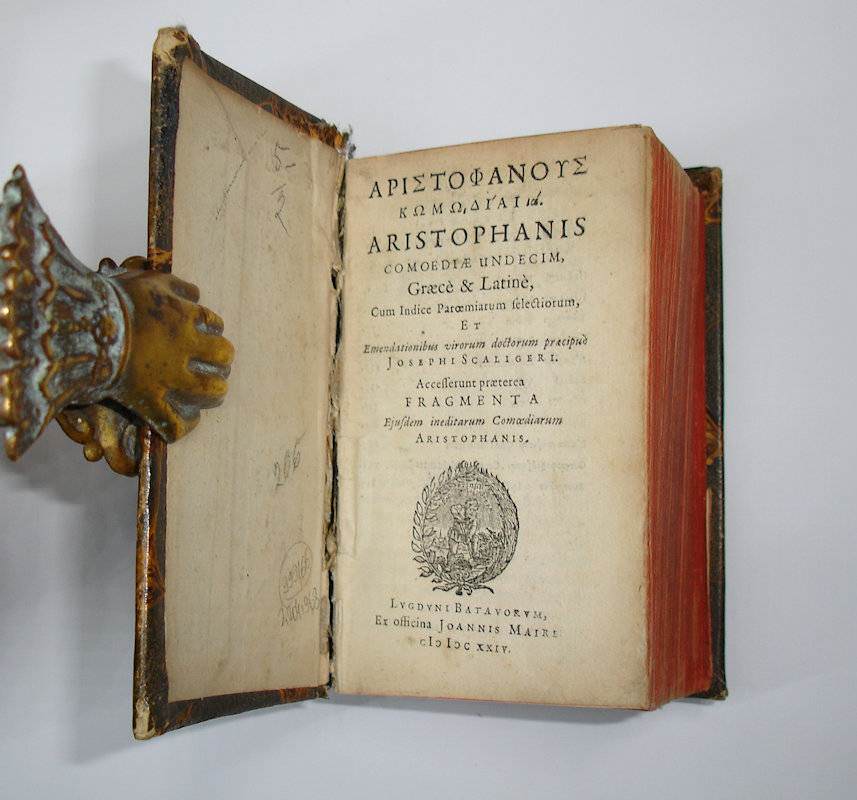
ARISTOPHANOUS KÔMÔiDIAI iá. Aristophanis comoediae undecim, graece & latine, cum indice paroemiarum selectiorum, et emendationibus virorum doctorum praecipue Josephi Scaligeri. Accesserunt praetera Fragmenta ejusdem ineditarum comoediarum Aristophanis.
€ 430,00
🔒 Safe & Secure Checkout


| Gewicht | 600 g |
|---|---|
| Publisher | Leiden (Lugduni Batavorum), Ex officina Joannis Maire, 1624. |
| SortedBy |
Gerelateerde producten
-

Joannis Alstorphii J.U.D. Dissertatio philologica De lectis. Subjicitur ejusdem De lecticis veterum diatribe.
€ 260,00 -

Appianus Alexandrinus De bellis civilibus Romanorum. Cum libro perquam eleganti, qui Illyrius, et altero qui Celticus inscribitur. (Translated from the Greek into Latin by Petrus Candidus)
€ 625,00 -

Aristaeneti Epistolae graecae cum versione latina et notis Josiae Merceri curante Joan. Cornelio de Pauw, cujus notae accedunt.
€ 225,00 -
A collection of dissertations: 1, Petrus Nieuwland: Dissertatio philosophico-critica De Musonio Rufo philosopho stoico. (Praeside D. Wyttenbachio, 1783) (Bound with:) 2, B.P. Van Wesele Scholten: Dissertatio philosophico-critica De Philosophiae Ciceronianae loco, qui est De Divina Natura. (Praeside D. Wyttenbachio, 1783) (&:) 3, B.P. Van Wesele Scholten: Dissertatio juridica De foedere Madritano, quod Franciscus I. Rex cum Carolo V. Imp. captivus fecit. (Praeside H.C. Cras, 1784) (&:) 4, Benjamin Petrus van Wesele Scholten: Dissertatio juridica inauguralis, Ad fragmentum Scaevolae, quod exstat in Leg. CII Princ. Dig. de Solut. et Liberat. (Praeside D.G. van der Keessel, 1785) (&:) 5, David Jacobus Van Lennep: Disputatio juris, sive ethico-juridica De loco Ciceronis qui est De Finibus Bonorum et Malorum. (Praeside H.C. Cras, 1793) (&:) 6, E.C. d’Engelbronner: Disputatio juris De loco Ciceronis qui est De Legibus. (Praeside H.C. Cras, 1802) (&;) 7, Jo. Conr. d’Engelbronner: Disputatio Historico-critica De M. Tullio Tirone M.T. Ciceronis liberto. (Praeside D.J. van Lennep, 1804) (&:) 8, Eliae Caroli d’Engelbronner: Oratio de Stoicorum, doctrinae in primis moralis, prae Epicuraeorum ratione praestantia. Habita, in templo Sancti Martini, quod Majus dicitur, A.D. XI. Septembris ann. 1805 cum Gymnasii Bomeliensis rectionem auspicaretur.
€ 280,00 -

AISCHULOU, PROMETHEUS DESMÔTÊS, HEPTA EPI THÊBAIS, PERSAI, AGAMEMNÔN, EUMENIDES, HIKETIDES.
€ 1.500,00 -

De vasculis libellus, adulescentulorum causa ex Bayfio decerptus, addita vulgari latinarum vocum interpretatione.
€ 800,00 -

Athanasiou dialogoi e’, peri tês hagias Triados. Basileiou logoi d’ kata dussebous Eunomiou. Anastasiou kai Kurillou ekthesis suntomos tês orthodoksou pisteôs. Athanasii dialogi V, de sancta Trinitate. Basilii libri IIII, adversus impium Eunomium. Anastasii et Cyrilli compendiaria orthodoxae fidei explanatio. Ex interpretatione Th. Bezae. Foebadi, sive Foebadii liber contra Arianos. Quae Athanasii, Anastasii & Cyrilli sunt, & quae Foebadii, nunc primum eduntur.
€ 1.300,00 -

ARISTAINETOU EPISTOLAI. Aristaeneti Epistolae graecae. Cum latina interpretatione & notis. Altera editio emendatior & auctior.
€ 740,00 -

Arriani Nicomedensis Expeditionis Alexandri libri septem, et Historia Indica graec. et lat. cum annotationibus et indice graeco locupletissimo Georgii Raphelii. Accedunt Eclogae Photii ad Arrianum pertinentes cum lectionibus variantibus Dav. Hoeschelii, summaria librorum distincta & emendata, index rerum accuratissimus, nec non tabula geographica Expeditionis Alexandri.
€ 350,00 -
Rerum gestarum qui de XXXI supersunt, libri XVIII. Ope MSS. codicum emendati ab Henrico Valesio, & auctioribus adnotationibus illustrati. Necnon excerpta vetera de Gestis Constantini & Regum Italiae. Editio Posterior, cui Hadrianus Valesius, F. Lindenbrogii in eundem Historicum ampliores observationes, et collectanea variarum lectionum adjecit, … emendavit, notisque explicuit.
€ 750,00