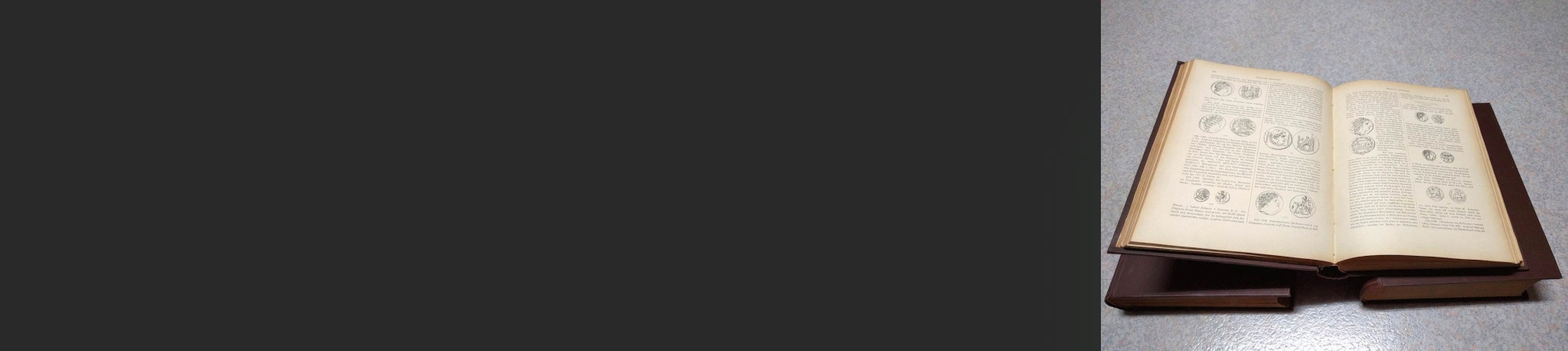
8vo. (XLVIII),352,64,(29 index),(1 blank) p., frontispiece. Half calf, frontcover detached. 19.5 cm (Ref: STCN ppn 063021110; Schoenemann I,72; Graesse 4,534; Ebert 14107) (Details: Back with 4 raised bands. Marbled boards. Frontispiece engraved by G. Appelmans, depicting 3 men, Octavius, Minucius and Octavius Januarius, discussing in the shadow of a tree, which grows on the border of a river, behind them a statue of a naked male figure, a statue of Serapis, in the distance the city. This is an illustration of the crucial scene as told by Minucius at the end of the second chapter, where Minucius tells how his friend Caecilius, as heathens used to do, threw a kiss to the statue. Octavius then criticizes Minucius for letting his friend walk ‘in hac inperitiae vulgaris caecitate’, the blindness of vulgar heathen ignorance, and to let him greet anointed stones (lapides), which are adorned with a laurel wreath (unctos et coronatos) (Condition: Binding scuffed. Upper board detached. Rear joint cracking, but still firm. Flyleaves gone. Blank upper margin of the frontispiece chipping and soiled. Some small inkstains. Bookplate on the front pastedown. Small name on the title) (Note: The Octavius is a dialogue in defence of the christian religion, and perhaps the oldest literary work of christian Latin. It was written by Minucius Felix, who lived in the second or third cent. A.D. In it he tries to prove that christian principles were not contrary to pagan culture, and that the Greek and Roman philosophers paved the path for christianity. The inspiration seems to come from Cicero’s dialogue ‘De Oratore’. The dialogue starts with Minucius recollections of the friendship he had with the recently deceased christian advocate Octavius. The setting is Ostia2). Minucius, Octavius Januarius, and the heathen Caecilius have come there to enjoy their holiday, free from ‘iudicariam curam’. Caecilius then launches a vehement attack upon the christians and their doctrines. It is the opinion of Octavius that no honorable Roman should leave a friend in the darkness of ignorance. He ridicules the folly of heathen fables, and proves the existence of providence and of God. Octavius warmly praises the purity, courage and other virtues of the christians. At the end Caecilius acknowleges himself vanquished and converted. § Jacobus Ouzelius (Oiselius), 1631-1686, born as Jacques Oisel (Oesel) in Dantzig, was only 21 when he edited this book. Although destined for a commercial career, he chose to study classical literature in Leyden. Later he switched to law and became professor of law in Groningen. He also edited Gaius and Gellius. (Van der Aa, vol. 14, p. 59) Ouzelius says in the ‘praefatio’ that he hopes that the reader will forgive him any mistakes, without ‘livor’ and ‘maledicentia’. He dedicates the book to Queen Christina of Sweden. Well, if we may believe Schoenemann, Christina had reason for complaint. Schoenemann is very critical about Ouzelius. He calls him a ‘futilissimus commentator’. ‘Omnia apta inepta incredibile stupore et imprudentia corrosa sunt’. The value of this edition lies, Schoenemann insists, in the printed commentaries of previous commentators. The reader should skip the notes of Ouzelius, and consult the presented notes of greater scholars, as Nicolaas Rigaltius, or Desiderius Heraldus, or Elmenhorst, or Wouwer.§ At the end has been added ‘De errore profanarum religionum’ by Julius Firmicus Maternus, edited by Wowerius, with his commentary. § Firmicus lived in the 4th century A.D. In it Firmicus urges the emperors Constans and Constantius, both sons of Constantine the Great, the man who in 313 A.D. had declared christianity to be the state religion, to take the next step, and abolish paganism. § This edition of 1672 is a reissue of the edition Leiden 1652. Schoenemann tells that the publisher increased the usefulness of the book by printing the notes of the commentators below the text. In the edition of 1652, all the notes of those scholars were printed separately at the end of the dialogue) (Provenance: name of one ‘John Bayly’ on the title. The owner of this apologetic dialogue might well be the Irish clergyman John Bayly, who was Dean of Lismore from 1828 until 1831. He was educated at Trinity College, Dublin. He was Chaplain to Henry Paget, 1st Marquess of Anglesey. He served as Dean of Killaloe from 1808 to 1828, when he was appointed Dean of Lismore. He died on 24 June 1831. (Source Wikipedia) § On the front pastedown tha armoral bookplate of one ‘R.W.B.’ The arms consist of a bar from which emerge 2 spread wings; they enclose a big heart, which is pierced or pinned down by a sword) (Collation: *-3*8, A-Y8, Aa-Ff8 (minus leaf Ff8, leaf Ff7 verso blank)) (Photographs on request)

M. Minucii Felicis Octavius. Cum integris omnium notis ac commentariis, novaque recensione Jacobi Ouzeli. Cujus & accedunt animadversiones. Insuper Johannis Meursii notae. Et liber Julii Firmici Materni V.C. De errore profanarum religionum.
€ 200,00
🔒 Safe & Secure Checkout


| Gewicht | 800 g |
|---|---|
| Publisher | |
| SortedBy |
Gerelateerde producten
-

Sancti Athenagorae Atheniensis Philosophi Deprecationem (vulgo Legationem) pro Christianis. Edidit M. Io.Gottlieb Lindner, rector Scholae Arnstadiensis. (Bound with:) HERMIOU PHILOSOPHOU DIASURMOS TÔN EXÔ PHILOSOPHÔN. Hermiae Philosophi Gentilium Philosophorum Irrisio. Cum adnotationibus Hier. Wolfii, Thomae Galei, Wilh. Worthii suisque. Graece in usum praelectionum separatim edidit Jo. Christoph. Dommerich, dialect. et philosoph. primae professor P.O. in Academia Helmstadiensi.
€ 180,00 -
Sancti Augustini Episcopi Hipponensis & Ecclesiae Doctoris opuscula quaedam selecta. (…) Editio quarta.
€ 90,00 -

D. Magni Ausonii Burdig. viri consularis opera. A Iosepho Scaligero, & Elia Vineto denuo recognita, disposita, & variorum notis illustrata (…) Adiectis variis & locupletissimis indicibus.
€ 920,00 -

Epigrammata et poematia vetera. Quorum pleraque nunc primum ex antiquis codicibus & lapidibus, alia sparsim antehac errantia, iam undecunque collecta emendatiora eduntur.
€ 750,00 -

Aristotelis Politicorum libri octo ex Dion. Lambini & Pet. Victorii interpretationibus puriss. graecolatini, Theod. Zvingeri Argumentis atque Scholiis, Tabulis quinetiam in tres priores libros illustrati, Victorii commentariis perpetuis declarati, Pythagoreorum veterum Fragmenta politica, a Io. Spondano conversa & emendata. Index rerum & verborum pleniss.
€ 1.700,00 -

Decii Ausonii Burdigalensis viri consularis varia opuscula dilegenter recognita.
€ 900,00 -
A collection of dissertations: 1, Petrus Nieuwland: Dissertatio philosophico-critica De Musonio Rufo philosopho stoico. (Praeside D. Wyttenbachio, 1783) (Bound with:) 2, B.P. Van Wesele Scholten: Dissertatio philosophico-critica De Philosophiae Ciceronianae loco, qui est De Divina Natura. (Praeside D. Wyttenbachio, 1783) (&:) 3, B.P. Van Wesele Scholten: Dissertatio juridica De foedere Madritano, quod Franciscus I. Rex cum Carolo V. Imp. captivus fecit. (Praeside H.C. Cras, 1784) (&:) 4, Benjamin Petrus van Wesele Scholten: Dissertatio juridica inauguralis, Ad fragmentum Scaevolae, quod exstat in Leg. CII Princ. Dig. de Solut. et Liberat. (Praeside D.G. van der Keessel, 1785) (&:) 5, David Jacobus Van Lennep: Disputatio juris, sive ethico-juridica De loco Ciceronis qui est De Finibus Bonorum et Malorum. (Praeside H.C. Cras, 1793) (&:) 6, E.C. d’Engelbronner: Disputatio juris De loco Ciceronis qui est De Legibus. (Praeside H.C. Cras, 1802) (&;) 7, Jo. Conr. d’Engelbronner: Disputatio Historico-critica De M. Tullio Tirone M.T. Ciceronis liberto. (Praeside D.J. van Lennep, 1804) (&:) 8, Eliae Caroli d’Engelbronner: Oratio de Stoicorum, doctrinae in primis moralis, prae Epicuraeorum ratione praestantia. Habita, in templo Sancti Martini, quod Majus dicitur, A.D. XI. Septembris ann. 1805 cum Gymnasii Bomeliensis rectionem auspicaretur.
€ 280,00 -

Athanasiou dialogoi e’, peri tês hagias Triados. Basileiou logoi d’ kata dussebous Eunomiou. Anastasiou kai Kurillou ekthesis suntomos tês orthodoksou pisteôs. Athanasii dialogi V, de sancta Trinitate. Basilii libri IIII, adversus impium Eunomium. Anastasii et Cyrilli compendiaria orthodoxae fidei explanatio. Ex interpretatione Th. Bezae. Foebadi, sive Foebadii liber contra Arianos. Quae Athanasii, Anastasii & Cyrilli sunt, & quae Foebadii, nunc primum eduntur.
€ 1.300,00 -

Appianus Alexandrinus De bellis civilibus Romanorum. Cum libro perquam eleganti, qui Illyrius, et altero qui Celticus inscribitur. (Translated from the Greek into Latin by Petrus Candidus)
€ 625,00 -

Apollonii Rhodii Argonauticorum libri quatuor. Edidit, nova fere interpretatione illustravit, priorum editorum notas praecipuas selegit, Sanctamandi nunquam prius editis nonnullas suas adjecit, necnon indices tres addidit, Joannes Shaw, A.M. Coll. Beatae Mariae Magdalenae apud Oxonienses socius.
€ 380,00