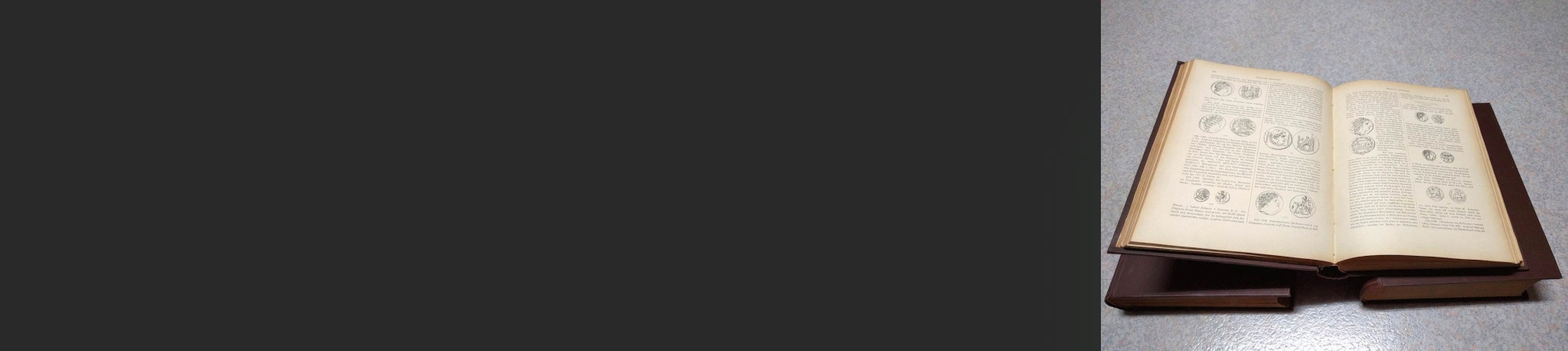
12mo. 52,117,(3) p. Calf 15 cm (Ref: Hoffmann 3,217; Graesse 5,369) (Details: Back with 4 raised bands; back and borders of the boards ruled blind. Woodcut printer’s mark on the title of Jean Lesnier, it depicts an eagle that soars above a city; in its beak a banner with the motto ‘movendo’. Woodcut headpieces and initials. Paper of excellent quality) (Condition: Binding a bit chafed, and slightly worn at the extremities. Tear in leaf A4) (Note: The Greek philosopher, historian and educator Plutarchus of Chaeroneia was born before 50 A.D., and died after A.D. 120. He is our most important witness of the spiritual climate of the first and second century A.D. He wrote numerous short treatises of popular moral philosophy, which go under the general name of the Moralia. They include debating themes, works in the form of question and answer, and serious discussions of philosophical topics. His warm and sympathetic personality can be traced in many treatises, which contain also a great deal of antiquarian knowledge picked up by Plutarchus in the course of his wide reading. (H.J. Rose, A Handbook of Greek literature, London 1965, p. 408). The Moralia were very influential in the Renaissance. ‘It is no exaggeration to say that Renaissance and early modern Europe discovered Greece and Rome through Plutarch’s eyes’. (The Classical Tradition, Cambr. Mass., 2010, p. 748). § Since the Plutarch edition of 1572 of Henri Estienne (Henricus Stephanus) the 76 treatises of the Moralia are divided into 14 books, and the Latin titles he gave to the treatises are still in use today. Our book is a translation into French of the 14th treatise, Plutarch’s essay on Superstition, ‘De Superstitione’, ‘?e?? de?s?da?µ???a?’ (Moralia, Book 2, 164E-171F). It is an attempt to prove that superstition is a dangerous venom, and far worse than atheism. Plutarch argues that the ‘atheist, when he is ill, takes into account and calls to mind the times when he has eaten too much or drunk too much wine, also irregularities in his daily life, or instances of over-fatigue or unaccustomed changes of air or locality; and again when he has given offence in administering office, and has encountered disrepute with the masses or calumny with a ruler, he looks to find the reason in himself and his own surroundings: Where did I err, and what have I done? What duty of mine was neglected? But in the estimation of the superstitious man, every indisposition of his body, loss of property, deaths of children, or mishaps and failures in public life are classed as ‘afflictions of God’ or ‘attacks of an evil spirit’. For this reason he has no heart to relieve the situation or undo its effects, or to find some remedy for it or to take a strong stand against it, lest he seem to fight against God and to rebel at his punishment; but when he is ill the physician is ejected from the house, and when he is in grief the door is shut on the philosopher who would advise and comfort him’. (Babbit’s translation of 168B-C in the Loeb Classical Library edition of the Moralia, 1928) § The treatise, which Faber calls ‘un des plus excellens traittés qui’ait iamais fait Plutarque’, (Préface p. 22) was translated by the French scholar Tanneguy Le Fèvre, latinized as Tanaquil Faber, 1615-1672, who was from 1665 ‘professeur de grec de l’Académie protestante de Saumur’. Faber was a diligent editor of Greek and Latin texts. He opposed contemporary superstition, which he calls ‘une maladie de l’ame’. (Préface p. 19) He considered atheists ‘irreligieux’ (…) gens sans religion’. (Idem p. 35). Faber is famous because of his daughter Anne, who married in 1664 the learned printer Jean (de) Lesnier, 1639-1675, when she was seventeen years old. So De Lesnier, who was printer for the protestant academy of Saumur, printed and published this translation for his father in law. After the publisher’s early death in 1675, Anne, widowed at the age of 28, married in 1683 André Dacier, pupil of her father, and became a respected classical philologist herself under the name of ‘Madame Dacier’. The work seems to be rare; we found in KVK only a few copies) (Collation: *-2*12, 3*2, A-E12) (Photographs on request)
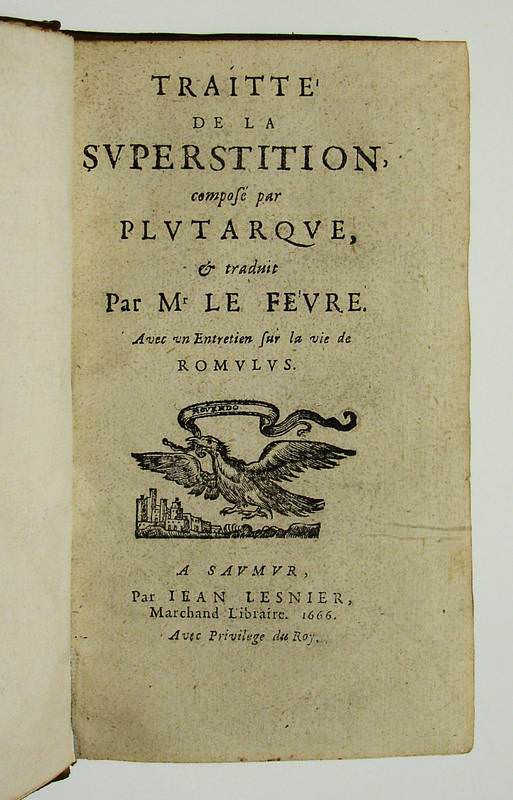


Traitté de la superstition, composé par Plutarque, & traduit par Mr. Le Fevre. Avec un Entretien sur la vie de Romulus.
€ 340,00
🔒 Safe & Secure Checkout


| Gewicht | 400 g |
|---|---|
| Publisher | |
| SortedBy |
Gerelateerde producten
-

ARISTOTELOUS PHUSIKÊS AKROASEÔS BIBLIA TH’. Aristotelis Stagiritae, Peripateticorum Principis, Naturalis auscultationis libri VIII. Jul. Pacius a Beriga cum Graecis excusis quam scriptis codicibus accurate contulit, Latina interpretatione auxit, & commentariis analyticis illustravit. Adiectus est geminus index: alter librorum, tractatuum & capitum: alter rerum & verborum in toto opere memorabilium.
€ 975,00 -

ARISTAINETOU EPISTOLAI. Aristaeneti Epistolae graecae. Cum latina interpretatione & notis. Altera editio emendatior & auctior.
€ 740,00 -

ARISTOTELOUS ÊTHIKÔN NIKOMACHEIÔN biblia deka. Aristotelis De moribus ad Nicomachum libri decem. Ita Graecis interpretatione recenti cum Latinis coniunctis, ut ferme singula singulis respondeant: in eorum gratiam, qui Graeca cum Latinis comparare volunt.
€ 1.000,00 -
A collection of dissertations: 1, Petrus Nieuwland: Dissertatio philosophico-critica De Musonio Rufo philosopho stoico. (Praeside D. Wyttenbachio, 1783) (Bound with:) 2, B.P. Van Wesele Scholten: Dissertatio philosophico-critica De Philosophiae Ciceronianae loco, qui est De Divina Natura. (Praeside D. Wyttenbachio, 1783) (&:) 3, B.P. Van Wesele Scholten: Dissertatio juridica De foedere Madritano, quod Franciscus I. Rex cum Carolo V. Imp. captivus fecit. (Praeside H.C. Cras, 1784) (&:) 4, Benjamin Petrus van Wesele Scholten: Dissertatio juridica inauguralis, Ad fragmentum Scaevolae, quod exstat in Leg. CII Princ. Dig. de Solut. et Liberat. (Praeside D.G. van der Keessel, 1785) (&:) 5, David Jacobus Van Lennep: Disputatio juris, sive ethico-juridica De loco Ciceronis qui est De Finibus Bonorum et Malorum. (Praeside H.C. Cras, 1793) (&:) 6, E.C. d’Engelbronner: Disputatio juris De loco Ciceronis qui est De Legibus. (Praeside H.C. Cras, 1802) (&;) 7, Jo. Conr. d’Engelbronner: Disputatio Historico-critica De M. Tullio Tirone M.T. Ciceronis liberto. (Praeside D.J. van Lennep, 1804) (&:) 8, Eliae Caroli d’Engelbronner: Oratio de Stoicorum, doctrinae in primis moralis, prae Epicuraeorum ratione praestantia. Habita, in templo Sancti Martini, quod Majus dicitur, A.D. XI. Septembris ann. 1805 cum Gymnasii Bomeliensis rectionem auspicaretur.
€ 280,00 -

Aristaeneti Epistolae graecae cum versione latina et notis Josiae Merceri curante Joan. Cornelio de Pauw, cujus notae accedunt.
€ 225,00 -

Sancti Athenagorae Atheniensis Philosophi Deprecationem (vulgo Legationem) pro Christianis. Edidit M. Io.Gottlieb Lindner, rector Scholae Arnstadiensis. (Bound with:) HERMIOU PHILOSOPHOU DIASURMOS TÔN EXÔ PHILOSOPHÔN. Hermiae Philosophi Gentilium Philosophorum Irrisio. Cum adnotationibus Hier. Wolfii, Thomae Galei, Wilh. Worthii suisque. Graece in usum praelectionum separatim edidit Jo. Christoph. Dommerich, dialect. et philosoph. primae professor P.O. in Academia Helmstadiensi.
€ 180,00 -

AISCHULOU, PROMETHEUS DESMÔTÊS, HEPTA EPI THÊBAIS, PERSAI, AGAMEMNÔN, EUMENIDES, HIKETIDES.
€ 1.500,00 -
Manuel militaire, ou cayers détachés sur toutes les différentes parties de l’art de la guerre. Cayer I. sur les convois.
€ 180,00 -

ARISTOPHANOUS KÔMÔiDIAI iá. Aristophanis comoediae undecim, graece & latine, cum indice paroemiarum selectiorum, et emendationibus virorum doctorum praecipue Josephi Scaligeri. Accesserunt praetera Fragmenta ejusdem ineditarum comoediarum Aristophanis.
€ 430,00 -

Athanasiou dialogoi e’, peri tês hagias Triados. Basileiou logoi d’ kata dussebous Eunomiou. Anastasiou kai Kurillou ekthesis suntomos tês orthodoksou pisteôs. Athanasii dialogi V, de sancta Trinitate. Basilii libri IIII, adversus impium Eunomium. Anastasii et Cyrilli compendiaria orthodoxae fidei explanatio. Ex interpretatione Th. Bezae. Foebadi, sive Foebadii liber contra Arianos. Quae Athanasii, Anastasii & Cyrilli sunt, & quae Foebadii, nunc primum eduntur.
€ 1.300,00